

If you’ve had a new boiler fitted in the last few years, there’s a good chance your engineer installed a small canister looking device, onto the pipework underneath it. Most people never ask what it is. It’s a central heating filter, and it’s quietly one of the most useful bits of kit in your house.
Here’s what it does, why it matters, and how to keep it working.
What is a central heating filter?
A central heating filter is a small device fitted to the pipe that carries water back into your boiler. Its job is to catch the debris floating around inside your heating system before that debris reaches the boiler.
Most modern ones are magnetic filters — the best-known being the Adey MagnaClean, though brands like Fernox, Spirotech and Worcester Bosch make their own versions. Inside is a powerful magnet that grabs metal particles as the water passes over it, plus a chamber that traps the non-magnetic gunk.
Think of it as a strainer for your heating system. Everything nasty gets caught in one place, where an engineer can wipe it out once a year, instead of ending up inside your boiler.
Where does the sludge come from?
This is the bit that surprises people. Your radiators and pipework are steel, and the water inside them contains a little oxygen. Steel plus water plus oxygen equals rust.
Over the years that rust breaks down into a fine black powder called magnetite — the sludge that engineers pull out of old systems. Add a bit of limescale and some flakes of old jointing compound, and you’ve got a thick, gritty mixture circulating through your heating.
That sludge causes real problems:
- Cold spots at the bottom of radiators, because the sludge settles and blocks the flow
- Blocked heat exchangers — the single most common reason a boiler dies early, and rarely a cheap repair
- Noisy pipes and kettling, that rumbling sound like a kettle boiling
- Seized pumps and sticking valves
- Higher gas bills, because your boiler works harder to push heat through a restricted system
A filter doesn’t stop the corrosion happening. It stops the results of it wrecking your boiler.
How does a magnetic filter work?
It’s simpler than it looks. The filter sits on the return pipe, so every drop of water heading back into the boiler goes through it first.
Inside, a rare-earth magnet attracts the magnetite, which sticks to it like iron filings. Heavier non-magnetic debris drops into the bottom of the chamber. Clean water carries on to the boiler.
There’s no power supply, no moving parts and nothing to go wrong. It just needs emptying.
Do I actually need one?
There’s no law forcing you to have one, but three things push firmly in that direction.
Building Regulations. Part L requires a heating system to be cleaned, flushed and dosed with inhibitor when a new boiler goes in. The British Standard that sits behind that work, BS 7593:2019, recommends fitting an in-line filter alongside the chemical treatment as best practice.
Your warranty. This is the one that catches people out. Many boiler manufacturers require a filter to be fitted — and serviced — as a condition of a long guarantee. If a heat exchanger blocks up with sludge and there’s no filter on the system, a warranty claim can be refused. With guarantees now running up to 12 years, that’s not a small risk.
Common sense. A filter costs a fraction of a new boiler. It’s cheap insurance.
Filters need servicing too
A filter isn’t fit-and-forget. Once the magnet is coated in magnetite, it can’t catch much more.
Cleaning it out is part of a proper annual boiler service. We isolate the filter, drain it, wipe the magnet clean, check the inhibitor level in the system and top it up if it’s low. It takes a few minutes and it’s the reason the filter keeps earning its keep.
BS 7593:2019 also recommends checking inhibitor levels annually and re-testing or re-dosing the system every five years. If your engineer has never mentioned either, it’s worth asking.
What does a central heating filter cost?
The filter itself is usually somewhere around £70–£100 depending on the model and your pipe size. Fitting it is a short job — draining down a section of pipework, cutting in the valves and refilling — so most homeowners end up paying roughly £200–£250 all in.
If you’re having a new boiler installed, a filter is normally included in the quote. Always check it is. If it isn’t, ask why.
Is it worth fitting one to an older system?
Usually, yes — but the order of work matters. If your system is already full of sludge, fitting a filter on its own is a bit like putting a strainer in a blocked sink. The system needs a proper clean first, either a chemical flush or a power flush, and then the filter keeps it clean afterwards.
The honest answer is that it depends on the state of your system. If your radiators are cold at the bottom, or the water that comes out of a bleed valve is black, get someone to look before you spend anything.
Frequently asked questions
Can I fit a magnetic filter myself? It involves draining part of the system and cutting into the pipework, so it’s a job for a qualified engineer. Getting it on the wrong pipe, or refilling without inhibitor, does more harm than good.
How often should a central heating filter be cleaned? Once a year, as part of your annual boiler service.
Are all magnetic filters the same? No. Capacity, magnet strength and how easy they are to service vary a lot between brands and models — which matters more than the badge on the front.
Does a filter replace inhibitor? No. They work together: inhibitor slows the corrosion, the filter catches what forms anyway. BS 7593 treats them as a pair.
Get your heating system protected
We fit and service boilers and magnetic filters across Bromsgrove, Redditch, Worcester, Droitwich, Rubery, Kidderminster and Stourbridge — as a standalone job, as part of a system clean, or included with a new boiler installation.
If 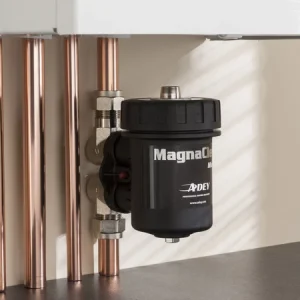 you’re not sure whether you’ve got a filter, or whether yours has ever been cleaned, we’re happy to take a look and tell you straight.
Call Heatex Climate Solutions on 01527 336 286 or drop us a message for a free, no-obligation quote.
Gas Safe registered. Worcester Bosch Accredited and Baxi Approved Installers. Fully insured.