

You turn the kitchen tap off and the pipes go bang. Or the washing machine fills, clicks shut, and something thumps under the floorboards like someone’s hit a pipe with a hammer.
It’s called water hammer, and it’s one of the most common calls we get that isn’t a breakdown. The usual cure is a small device called a mini expansion vessel or a shock arrestor — two things that look similar, do related jobs, and get muddled up constantly.
Here’s what they are and why modern houses need them far more than old ones did.
What is water hammer?
Water in your mains pipework is heavy, and when a tap is running it’s moving at speed.
Close that tap slowly, like an old-fashioned screw-down tap, and the water slows down gently. Close it suddenly — a quarter-turn lever tap, or the electric solenoid valve inside a washing machine or dishwasher — and all that moving water stops dead in a fraction of a second.
It has to put that energy somewhere. So it sends a pressure wave back down the pipe, which hits the next bend or fitting and makes the pipe jump. That’s the bang.
It’s not just noise. Repeated shock loading loosens joints, wears out tap washers and valve seats, and over time it genuinely causes leaks. The Water Supply (Water Fittings) Regulations 1999 require plumbing to be installed so it doesn’t cause water hammer, so it’s not something to just live with.
What is a shock arrestor?
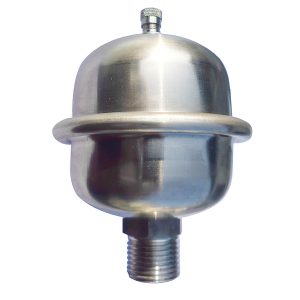
A shock arrestor is a small sealed cylinder that tees into the pipework near whatever is causing the bang.
Inside it there’s a rubber diaphragm with a cushion of air or nitrogen behind it. When that pressure wave arrives, the diaphragm flexes and the air compresses, absorbing the shock — like a shock absorber on a car soaking up a pothole instead of transmitting it straight into the chassis.
Because it’s a sealed air cushion rather than an open pipe full of trapped air, it doesn’t gradually waterlog and stop working the way old-style standpipe fixes did.
What is a mini expansion vessel?
A mini expansion vessel looks almost identical — small cylinder, rubber diaphragm, air charge behind it — but it’s solving a slightly different problem: thermal expansion in a closed system.
Water expands when you heat it. In an old house that was fine, because the expansion just pushed gently back up the mains. But in a modern home, the water often can’t get back out. Two common reasons:
Your water meter has a check valve in it, which lets water in and not back out
Your combi boiler has a non-return valve on its cold inlet, so once water is in the boiler it can’t reverse
The moment you close that loop, your plumbing becomes a sealed container. Heat the water in it and the pressure climbs fast, with nowhere to go.
A mini expansion vessel gives it somewhere to go. The expanding water pushes the diaphragm, the air behind it compresses, the pressure stays sensible.
So which one do I need?
The honest answer is that the two overlap, and plenty of installers use the terms interchangeably because the same device often solves both problems. But as a rough guide:
Bangs when a tap or appliance shuts off → that’s shock, and a shock arrestor near the culprit is the fix
Combi’s pressure relief drips outside, or pressure creeps up after hot water use → that’s thermal expansion, and a mini expansion vessel on the cold inlet is the fix
Both happening → one correctly sized and correctly positioned vessel usually deals with both
Where does it get fitted?
Position matters more than people expect, and it’s the most common reason one doesn’t work.
For thermal expansion, it goes on the cold mains inlet as close to the boiler or cylinder as you can practically get it — between the boiler’s cold connection and the nearest tee.
For shock, it goes close to the thing causing the bang. A vessel fitted in the airing cupboard won’t do much about a washing machine valve slamming shut at the other end of the house.
They can be fitted on horizontal or vertical pipe and are usually teed in with compression fittings, so it’s a short job.
The bit that gets missed: the air charge
A mini expansion vessel has a pre-charge of air behind the diaphragm, set through a valve that looks like a car tyre valve.
That charge has to be set to suit your incoming mains pressure. Too low and the vessel sits permanently compressed and does nothing. Too high and the water can’t push the diaphragm at all, and it does nothing. Either way you’ve got a device on the wall that isn’t working.
This is why it’s worth having one fitted by someone who’ll actually measure your standing mains pressure first rather than fitting it straight out of the box. It’s a five-minute check that decides whether the whole job works.
Like any expansion vessel, the charge can also be lost over years of service, so if an old one has stopped helping it may just need re-pressurising rather than replacing.
Before you spend anything
Not every bang needs a vessel. A few things worth ruling out first, and you can check most of them yourself:
Loose pipe clips. A pipe under floorboards or in an airing cupboard that isn’t clipped properly will rattle against a joist. Often the whole problem.
A failing tap washer or ballvalve, which can cause a shudder rather than a single bang.
Very high mains pressure. If your incoming pressure is unusually high, a pressure reducing valve may be the better answer, and it’ll be kinder to the whole house.
A good engineer will check these before selling you hardware. If someone reaches for a vessel without measuring anything, get a second opinion.
Why fit one with a new boiler?
Here’s something that catches a lot of people out: the banging often starts right after a new boiler goes in. The homeowner blames the boiler, the installer insists the boiler is fine, and they’re both sort of right.
The reason is that most modern combis have a non-return valve on the cold inlet. The old boiler probably didn’t. The moment the new one goes on, water that used to be able to push gently back up the mains can’t any more — and if your water meter has a check valve in it too, the cold side of your plumbing is now a sealed system. Heat the water, pressure climbs, and something has to give.
That’s why fitting a mini expansion vessel at installation time makes sense:
It prevents a problem instead of chasing one. A vessel fitted on day one means the pressure has somewhere to go from the first time the boiler fires. No banging, no creeping pressure, no nuisance drip from the pressure relief pipe outside.
It stops good work getting blamed for bad symptoms. Nobody wants a brand new boiler and a house that suddenly bangs every time the dishwasher fills. It’s an easy thing to design out at the start and an irritating thing to diagnose afterwards.
The pipework is already open. Same as any other addition — during an installation the water is off and the pipes are apart. Teeing in a vessel costs minutes. Coming back to do it later is a separate visit, a separate drain-down and a separate bill.
The pressure gets set properly. A good installer measures your standing mains pressure as part of commissioning anyway, so setting the vessel’s pre-charge to match is a natural part of the job rather than an afterthought. As covered above, that setting is the difference between a vessel that works and one that just sits there.
It protects the new boiler’s own components. Repeated pressure spikes are hard on valves, seals and diaphragms — including the ones inside your new boiler. Sm
oothing them out is cheap insurance on an expensive appliance.
Not every installation needs one, and we wouldn’t fit one where it isn’t warranted. But if your home has a metered supply, lever taps or modern appliances — which is most homes now — it’s worth raising with whoever is quoting you.
What does it cost?
The vessel or arrestor itself is typically £25–£70 depending on size and type. Fitted on its own, most homeowners pay somewhere around £120–£180, assuming it’s a straightforward tee into accessible pipework.
Added during a boiler installation it’s far cheaper, since the system is already drained and the pressure checks are being done anyway.
Frequently asked questions
Is water hammer dangerous? It won’t hurt you, but it’s not harmless to your plumbing. Repeated pressure spikes loosen joints and wear out valves, and leaks are the eventual result. It’s worth sorting.
Is a mini expansion vessel the same as my boiler’s expansion vessel? No.
Your boiler has its own expansion vessel for the heating circuit — the sealed loop of water going round your radiators. A mini expansion vessel deals with the mains cold water side. Different circuits, different jobs.
Why has this only started recently? Usually because something changed. A new water meter, a new combi, a new washing machine, or new lever taps. Any of those can close the loop or introduce a fast-closing valve into plumbing that was fine for years.
Can I fit one myself? It’s a tee into live mains, plus setting the pre-charge correctly. The plumbing is simple; getting the pressure right is the part that decides whether it works.
My combi’s outside pipe drips after we run hot water — is this it? It can be. A dripping pressure relief can be thermal expansion with nowhere to go, but it can also be a failed vessel inside the boiler or a passing valve. Worth having someone diagnose it properly rather than guessing.
Got banging pipes? We’ll find out why
We diagnose and fix water hammer across Bromsgrove, Redditch, Worcester, Droitwich, Rubery, Kidderminster and Stourbridge — checking pressure and pipework first, and fitting a shock arrestor or mini expansion vessel only where it’s actually the answer.
Call Heatex Climate Solutions on 01527 336 286 or drop us a message for a free, no-obligation quote.
Gas Safe registered. Worcester Bosch Accredited and Baxi Approved Installers. Fully insured.