

If you live in Worcestershire, you already know about limescale. It’s the chalky crust on the kettle element, the white spots on the shower screen, the taps that never quite look clean.
What you can’t see is the same stuff building up inside your boiler. That’s what an electrolytic scale reducer is there to slow down — and it’s a small, cheap device that a lot of homeowners have never heard of.
Here’s a straight explanation of what it is, what it does, and just as importantly, what it doesn’t do.
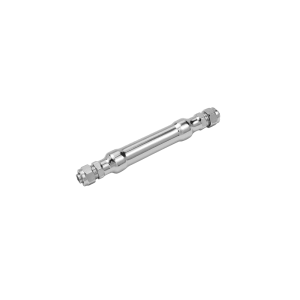
What is an electrolytic scale reducer?
An electrolytic scale reducer is a short section of pipe, usually 15mm or 22mm, that gets plumbed into your cold water supply using compression fittings — the nut-and-olive joints that tighten with a spanner rather than needing heat and solder.
It’s about the size of a fat marker pen. There’s no power supply, no batteries, no cartridge to change and nothing to plug in. Once it’s in, it just sits there.
Inside is a small electrolytic cell containing a sacrificial metal element, usually zinc. As water flows past, a very small electrical reaction takes place between the dissimilar metals in the cell.
How does it actually work?
This is where a lot of websites get vague, so let’s be clear about it.
Hard water carries dissolved calcium and magnesium. When that water is heated, those minerals come out of solution and crystallise. Left alone, the crystals grow in a form that sticks hard to hot surfaces — your heat exchanger, your immersion element, the inside of your pipes. That’s limescale.
An electrolytic scale reducer doesn’t remove those minerals. What it does is change the shape of the crystals as they form, so that instead of locking onto hot metal they stay suspended in the water and get carried away and down the drain.
Manufacturers describe this as altering the crystal structure or inducing coagulation. In plain terms: the scale still forms, but it forms as a powder that flows away rather than a crust that welds itself to your boiler.
Do I need one in Worcestershire?
Almost certainly worth considering, yes.
Most of Worcestershire is supplied by Severn Trent, and their water is classed as hard — published figures put the average around 220 parts per million. Building Regulations Part L and BS 7593:2019 both point to treating water above 200ppm to protect water heaters and boiler circuits.
So we’re over the threshold where treatment is recommended, right across Bromsgrove, Redditch, Droitwich and the surrounding villages.
There’s a second reason too: some boiler manufacturers ask for scale protection in hard water areas as a condition of their longer guarantees. Worth checking your paperwork if you’ve got a 10 or 12 year warranty riding on it.
What limescale actually costs you
Scale is an excellent insulator. That’s great in a loft and terrible inside a boiler.
A layer of scale on a heat exchanger means the burner has to work harder and longer to push the same amount of heat into your water. You pay for that in gas. Worse, the metal underneath gets hotter than it was designed to — which is how heat exchangers crack and fail early.
In a combi, the plate heat exchanger that makes your hot water is particularly vulnerable, because it’s small, it runs hot, and every drop of mains water passes through it. The classic symptom is hot water that starts strong and then fades, or a shower that runs hot and cold.
Where does it get fitted?
On the cold mains pipe feeding the boiler or hot water cylinder, before the water gets heated. It works on cold water only — there’s no point fitting one downstream of the boiler, because by then the damage is done.
It can go on horizontal or vertical pipework, which makes it easy to fit in the cramped cupboard most boilers live in. Fitting takes well under an hour: isolate the water, cut the pipe, tighten two compression joints, turn back on and check for leaks.
One thing worth knowing — because it’s a compression device, it shouldn’t be soldered near. Heat and flux residue can damage the cell.
How long does one last?
Most manufacturers quote around 10 years, depending on how much water you use, and no maintenance in between. The element is sacrificial, so it does gradually get used up.
If your boiler is 12 years old and had a scale reducer fitted with it, that device has almost certainly done its job and stopped. Replacing it at the same time as a new boiler makes sense.
Being honest about the limits
A scale reducer is not a water softener, and anyone telling you otherwise is overselling it.
It doesn’t soften your water. The hardness minerals are still there. Your kettle will still scale, your soap still won’t lather, and your shower screen will still spot.
It won’t undo existing scale. If a heat exchanger is already furred up, it needs cleaning or replacing first.
A water softener does more — it actually removes the hardness — but it costs considerably more, needs salt topping up, and takes up cupboard space.
Think of a scale reducer as sensible, low-cost protection for the expensive bit of kit, not as a whole-house water treatment system. For most homeowners in a hard water area, that’s exactly the right trade-off.
Why fit one with a new boiler?
If you’re having a boiler replaced, this is the moment to do it. Four reasons.
Your warranty may depend on it. Modern boilers come with long guarantees — up to 12 years on some models — and manufacturers protect themselves by setting conditions. In a hard water area, scale protection is frequently one of them. A heat exchanger that fails from limescale, on a system with no scale protection fitted, is exactly the sort of claim that gets refused. Check the terms on the boiler you’re being quoted for.
A new boiler is more vulnerable than the one it replaces. Older boilers had chunky cast iron heat exchangers with wide waterways that tolerated a bit of scale. Modern condensing boilers are efficient precisely because they’re compact — thin stainless steel plates and narrow channels, running hotter. That design gets far more out of your gas, but it also gives limescale much less room to build up before it starts causing problems.
The labour is almost free at that point. Fitting a scale reducer on its own means draining down, cutting into live mains and refilling — a chargeable visit for a small part. During a boiler swap the water is already off and the pipework is already open. Adding it takes an engineer a few extra minutes, which is why it costs so much less bundled into the installation than fitted a year later.
You protect it from day one. Scale doesn’t announce itself. It builds quietly for years and the first symptom is usually hot water that’s gone weak or a shower that swings hot and cold — by which point the damage is done and you’re looking at cleaning or replacing the heat exchanger. Protection fitted on day one is the only kind that covers the whole life of the boiler.
If a quote you’ve been given doesn’t include one, it’s a fair question to ask why. In a hard water area like ours there’s usually no good answer.
What does it cost?
The device itself is usually somewhere in the region of £30–£70 depending on size and brand. Fitted on its own, most people pay around £100–£150 including the labour.
Bundled into a new boiler installation it’s a fraction of that, for the reasons above — which is exactly why we’d rather fit it then than have you call us about weak hot water in five years.
Frequently asked questions
Do electrolytic scale reducers really work? They reduce scale build-up rather than eliminating it, and they’re widely used and recommended by manufacturers for hard water areas. They’re a preventative measure, not a miracle cure — but they’re cheap, maintenance-free and protect the most expensive part of your heating system.
Is it the same as a magnetic filter? No, and the two do completely different jobs. A magnetic filter goes on the heating circuit and catches rust and sludge. A scale reducer goes on the cold mains and tackles limescale. Plenty of homes need both.
Can I fit one myself? It’s a compression fitting on a live mains pipe. If you’re confident isolating and draining the mains it’s a simple job, but a bad joint on incoming mains makes a serious mess. Most people would rather have it done properly.
Does it need electricity? No. The electrolytic reaction happens on its own between the metals in the cell.
Will it help my kettle and shower? Some homeowners notice less scale downstream, but that’s not what it’s designed for. If soft water throughout the house is what you’re after, you want a water softener.
Not sure what protection your boiler has?
We fit scale reducers, magnetic filters and full system protection across Bromsgrove, Redditch, Worcester, Droitwich, Rubery, Kidderminster and Stourbridge — as a standalone job, or as part of a new boiler installation.
If you’ve got hard water and an expensive boiler, it’s worth five minutes to check what’s protecting it. We’ll tell you straight whether you need anything or not.
Call Heatex Climate Solutions on 07947156905 or drop us a message for a free, no-obligation quote.
Gas Safe registered. Worcester Bosch Accredited and Baxi Approved Installers. Fully insured.